 SK
 CZ
 EN
 DE
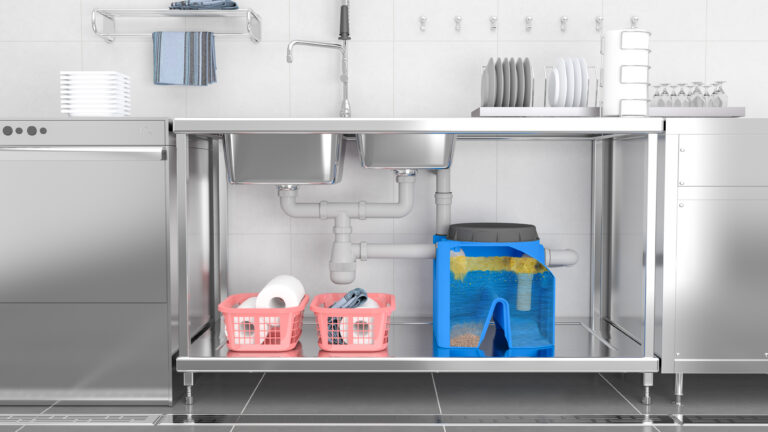
An automatic grease separator is a device that continuously removes fats, oils and grease (FOG) from kitchen wastewater before they reach the sewer system. Unlike manual grease traps, it discharges the captured fat automatically according to a programmed schedule, so it maintains constant efficiency without manual emptying. It is designed primarily for restaurants, canteens and other catering establishments with a higher wastewater flow rate.
Why deal with fats in wastewater
Tonnes of grease and fat enter the sewer system every year — it is estimated that up to 50% of all sewer overflows are caused by accumulated grease. All types of catering establishments are significant producers of greasy waste: waste fat is generated during food preparation in sinks, dishwashers and cooking equipment such as combi ovens, commercial woks, fryers and grill ovens.
If waste fats are not managed in the establishment, they accumulate in the pipework, where they cause blockages and overflows. The problems are not limited to the public sewer system — blocked internal kitchen pipework means expensive repairs, equipment downtime and the resulting losses. Across the world, legislation is therefore being adopted that requires food service operators to manage FOG properly and to install an interception device before wastewater is discharged; polluters who handle fat waste inefficiently face high fines.
Manual or automatic separator?
Grease separators are nothing new — they have been used to separate fat mass since Victorian times (the first patent was granted to Nathaniel Whiting at the end of the 19th century). Today the market offers a wide range of models made of various materials (stainless steel, plastics, concrete, cast iron) with volumes ranging from 35 litres for under-sink kitchen separators up to 45,000 litres and more for underground tanks outside the building.
In small establishments, manual grease separators have their place. Larger establishments with higher flow rates and higher production of greasy waste, however, require more powerful — automatic — devices. Although they involve higher initial investment costs, in the long term the investment pays off better: they are more efficient and have lower operating and servicing costs.
The reason is simple: the efficiency of a grease trap is directly related to the amount of fat inside it. In a manual trap, fat accumulates until it is emptied by hand, and as the internal capacity decreases, so does the efficiency. An automatic trap removes FOG continuously according to a schedule — fat does not build up inside and the system operates at maximum efficiency at all times. Automatic separators can remove up to 95% of fat and solids, and thanks to its purity the captured oil is suitable for direct recycling.
How an automatic separator works
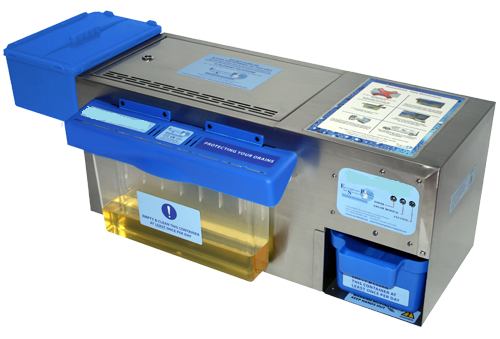
The principle is initially the same as with a manual trap: the wastewater flow is slowed down, the water cools, and the fat separates and rises to the surface. This is where the similarity ends, however — the separated fat does not form a solid layer; instead, the system automatically reheats it and transfers it from the surface into a collection container that is part of the device. From there it can be conveniently poured in liquid form into a larger collection container and recycled.
Automatic separators almost always also include a removable strainer basket for collecting solids, so only a minimum of solid waste settles at the bottom of the device. The operator gets fat removal according to a pre-programmed schedule — with no constant checking of the grease level, no manual fat removal, no topping up with clean water and no biological agents, enzymes or chemicals.
GS automatic grease separators
In our range you will find a selection of automatic under-sink kitchen separators — an effective fat waste management solution where a large separator cannot be installed. Space-saving models such as the GS1000 or the GS1850 AST are ideal for smaller kitchens; the basic model can be extended with a pre-filter or a mechanical impurity filter, or a low-level extended variant can be chosen. For the smallest establishments, the compact MINI ST24 grease separator is available.
Main advantages of GS separators
- Excellent performance — more than twice as efficient compared with other fat management systems.
- Cost savings — elimination of frequent pumping; collection of 7 litres of FOG per day on average.
- Easy operation — staff do not need access to the inside of the device; the lids have an integrated lock against unauthorised access.
- Safety — no heating element, therefore no fire risk.
- Environmentally friendly — the captured fat is a source of renewable energy.
- Durable material — internal tanks made of polypropylene copolymers resistant to high temperatures and pH changes, injection-moulded in a single piece, housed in a stainless steel cabinet. Unlike polyethylene, the material does not contribute to odour formation at the typical wastewater temperature of around 40 °C.
- The lowest energy consumption in its class — the smallest GS separator consumes only 16 W per hour (comparable devices on the market up to 1500 W/h); low-level models 22 – 47 W/h. The savings are made possible by using the waste heat of the water.
How it works technically
- The GS separator operates in real time and uses the waste heat energy of the kitchen water to separate and remove fats before they solidify. It removes and dewaters organic solid waste through a pre-filter or FilterShield® filter, preventing biological degradation and odour formation.
- The heart of the device is an oleophilic and hydrophobic drum that attracts fat and repels water; it is wiped by a long-life silicone rubber blade. The drum operates in 5-minute intervals (5 min on, 5 min off).
- Clean wastewater is recirculated (10 seconds every 90 seconds while the drum is running) — this increases FOG removal efficiency and assists the internal self-cleaning of the device.
- The FOG collection container is graduated, so a daily record of the amount of fat removed can be kept; a maintenance logbook is included in the delivery.
- The devices have integrated flood protection, vent screws for taking wastewater samples without tools and a vortex flow regulator.
Maintenance
- The separator operates during kitchen hours — the standard programme is set from 07:00 to 02:30 the following morning, but it can also be set to continuous 24/7 operation.
- The container for collecting the separated fat and the pre-filter/mechanical impurity filter must be emptied and washed daily.
- The delivery includes a water spray gun with a hose, which makes daily cleaning of the inside of the separator and the filters considerably easier.
- LED indicators signal FOG removal, the recirculation function and mains power (the unit requires its own IP 56 socket under the counter).
Read more on the topic in the articles Grease separator: are you using one? and Manual grease separators.
FAQ
How much grease can an automatic grease separator capture?
Automatic grease separators can remove up to 95% of fat and solid particles from wastewater. Thanks to its purity, the captured oil is suitable for direct recycling — GS separators collect on average about 7 litres of grease per day.
What is the difference between a manual and an automatic grease separator?
In a manual grease trap, fat accumulates until it is emptied by hand, and as the capacity decreases, so does the efficiency. An automatic separator removes grease continuously according to a programmed schedule, so it always operates at maximum efficiency. It requires a higher initial investment but has lower long-term operating and servicing costs.
How often does an automatic grease separator need to be cleaned?
The container for collecting the separated grease and the pre-filter or mechanical impurities filter must be emptied and washed daily. GS separators come supplied with a water spray gun with a hose to make cleaning easier, together with a daily maintenance logbook.
How much energy does an automatic grease separator consume?
The smallest GS separator consumes only 16 W per hour — comparable devices on the market can consume as much as 1500 W/h. Entry-level GS models typically consume 22 to 47 W/h. This low consumption is possible thanks to the use of waste heat energy from kitchen water.
Is a grease separator mandatory in a food service establishment?
Around the world, legislation is increasingly being adopted that requires food service operators to manage fat, oil and grease (FOG) waste and to install a capture device before discharging wastewater into the sewer system. Polluters who handle grease waste inefficiently face heavy fines.