 SK
 CZ
 EN
 DE

A grease separator is a flow-through device that mechanically separates fats, oils and grease (FOG) from wastewater before they enter the sewer system and clog it. Blocked drains are a nightmare in every household as well as in every professional establishment – and we rarely stop to think about how such troubles arise and, above all, how to prevent them.
Do you know what is happening in your drain?
The most common culprit behind a kitchen pipe that will not drain is kitchen waste in the wastewater: solid particles, oil, grease and other substances, known in professional practice under the abbreviation FOG (fat – oil – grease). Grease and food residues get into the drain when washing plates, pots and pans, but occasionally also through the irresponsible pouring of fats directly into the sink.
Although pouring oil down the drain may look innocent at first glance, the opposite is true. As it passes through the pipes, the oil cools quickly, solidifies on the walls and keeps forming new layers. Once mixed with solid impurities – food residues and starches – it eventually creates a solid, impermeable barrier that restricts or completely stops the flow of water. Greasy deposits are also a source of unpleasant odour. Moreover, water contaminated in this way causes enormous problems in wastewater treatment plants, and the pollution penetrates all the way into rivers and groundwater.
What can be done about it?
The only way to prevent blocked drains and the associated odour is pre-treatment of the water you discharge from the sink into the sewer. Special devices – grease separators – are used to pre-treat wastewater contaminated with fats or organic oils. By installing a correctly selected separator, you can very effectively prevent pipe blockages and the release of odours.
Do I need a grease separator?
The main indication is a sewer system highly prone to the accumulation of deposits, or the expected discharge of wastewater with an increased concentration of oily substances. Establishments that need a separator automatically include all kitchen and food-processing operations where fats are released into the wastewater – in catering establishments in particular, various forms of oils and fats are among the most frequent daily waste.
Do you know what the law says?
Biodegradable kitchen and restaurant waste, including edible oils and fats, is divided into household waste and waste from the operation of catering facilities (kitchens, restaurants, school kitchens, catering facilities of social service homes and healthcare facilities, buffets, food stalls, etc.). Every operator is obliged to familiarise themselves with the Waste Act (Slovakia) as well as with the generally binding regulations of the municipality. In general, the kitchen operator is responsible for managing the biodegradable waste it has produced, and the law directly prohibits discharging oils and fats into the sewer system. Grease separators are therefore an excellent way to comply with the law, keep your establishment hygienically clean, reduce the cost of cleaning drain pipes and contribute to protecting the environment.
How a grease separator works
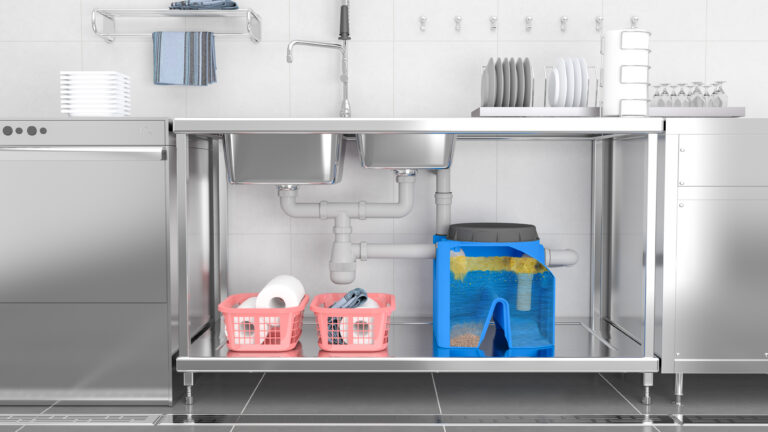
Grease separators are flow-through devices – as the water flows through, the grease is mechanically separated from the rest of the wastewater. Separation is made possible by the process of flotation: animal fats and vegetable oils are considerably less dense than water, so fine fat particles combine and form a layer that floats on the surface. Solid impurities, which are heavier than water and insoluble, settle by gravity at the bottom of the separator in the sedimentation chamber and form sludge (sedimentation). The separator inlet slows down the flow of the wastewater so that the individual layers do not mix.
Manual or automatic?
Both types perform essentially the same task of separating and controlling FOG. Choosing the right separator depends on your operating processes and on the type and quantity of wastewater produced. First, the nominal flow rate must be correctly determined (the quantity of process wastewater flowing through the device in l/s) – this determines the basic characteristics of the separator, such as the diameter of the inlet and outlet or the capacities of the sedimentation and separation chambers. Smaller separators are used for dishwashing water, while larger ones are used, for example, in meat, dairy and fish processing plants.
Manual grease separators are small, compact, very affordable devices that do not require an electrical connection – such as the MINI ST24 grease separator. They are a suitable solution mainly for small catering establishments: installation is inexpensive, but they require more frequent maintenance and regular manual removal of grease and sludge. Historically, they are the most commonly used solution in commercial kitchens – they have been in use for more than a century. They are installed directly in the cabinet under the kitchen sink and near the dishwasher; they are usually made of stainless steel or quality plastic.
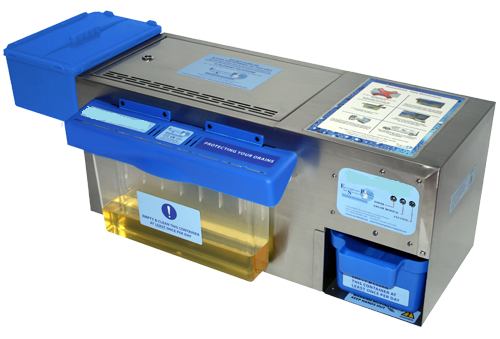
Automatic grease separators – for example the GS1000 automatic separator – are larger devices and a somewhat more expensive alternative. However, the investment quickly pays for itself in savings on pipe and sewer maintenance and in minimal maintenance time. They are installed under the kitchen sink or connected to several kitchen appliances at once; the largest models, with volumes of several thousand litres, are installed outdoors in the ground. They require an electrical connection and about 10 minutes of maintenance per day. They almost always include a removable strainer basket for collecting solid impurities, and a major advantage is that you do not have to collect the separated grease by hand – the fats are automatically separated into a dedicated container, ready for further use.
Maintenance
The performance of both types depends on how well they are maintained. Manual grease traps are emptied by hand – depending on the amount of waste produced, approximately every 2–4 weeks. Automatic separators can be emptied daily, directly into a separate collection container. All types should be positioned so that they can be opened and cleaned easily. Domestic sewage, rainwater and wastewater containing light liquids and mineral oils should not be fed into the separators.
Let’s help nature
The captured grease does not end up in the sewer but in a collection container, from where it can be handed over for further recovery – and more and more municipalities are adding containers for the separate collection of used edible oils and fats. Have we inspired you to get the hygiene and cleanliness of your kitchen under control? Browse the range of separators in the waste collection and sorting category – we will be happy to help you choose the right model for your establishment.
FAQ
What does the abbreviation FOG stand for?
FOG stands for fat – oil – grease. It refers to kitchen residues in wastewater, which are the most common culprit behind clogged kitchen pipes.
Is discharging grease into the sewer system prohibited?
Yes. Every kitchen operator is responsible for how they handle the biodegradable waste from their establishment, and the Waste Act directly prohibits discharging oils and fats into the sewer system. Operators are also obliged to familiarise themselves with the generally binding regulations of their municipality.
How does a grease separator work?
Grease separators are flow-through devices – as the water flows through, grease is mechanically separated from the rest of the wastewater by flotation. Fats and oils are less dense than water, so they rise and form a layer on the surface, while heavier solid impurities settle at the bottom of the sedimentation chamber as sludge.
Should I choose a manual or an automatic separator?
Manual separators are small, compact and affordable devices that require no electricity – particularly suitable for small food service establishments. Automatic separators are larger and more expensive, but the investment quickly pays off in savings on pipe maintenance and minimal maintenance time – they require only about 10 minutes a day.
How often does a grease separator need to be cleaned?
Manual grease traps are emptied by hand approximately every 2 to 4 weeks, depending on the amount of waste. Automatic separators can be emptied daily – the grease is separated directly into a dedicated collection container.